
Introduction: The High-Stakes Math of Customer Value
In the competitive world of e-commerce, long-term success is not just about driving sales; it's about driving profitable sales. The ultimate measure of a business's sustainable growth and long-term viability can be distilled into a single, powerful metric: the Lifetime Value to Customer Acquisition Cost (LTV/CAC) ratio. This isn't just an abstract financial calculation; it's the fundamental math that determines whether your business model is creating or destroying value with every new customer you acquire. For high-performing businesses, achieving a ratio of seven times or more is a clear indicator of a highly effective growth engine, often powered by strategic investments in customer loyalty that turn one-time buyers into lifelong advocates.
Defining the LTV/CAC Ratio
The LTV/CAC ratio is a key performance indicator that compares the total value a customer generates for your business over their entire relationship (Lifetime Value or LTV) against the total cost required to acquire that customer in the first place (Customer Acquisition Cost or CAC). In essence, it answers the critical question: for every dollar we spend to acquire a new customer, how many dollars in value do we get back?
Understanding the Benchmark for Success
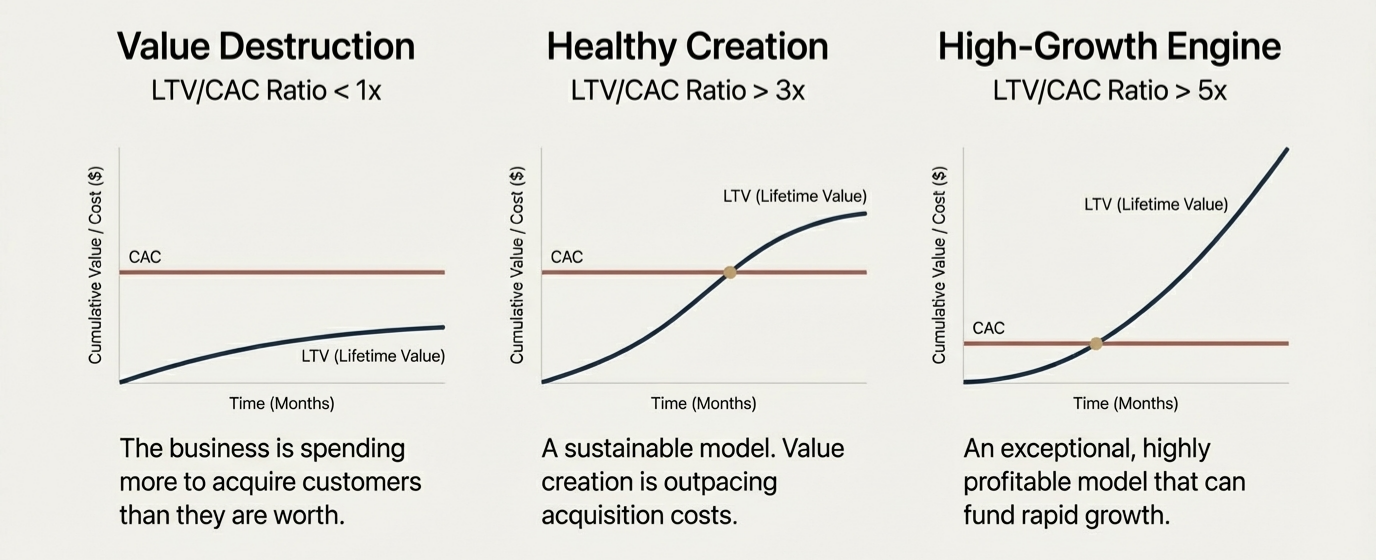
Interpreting your LTV/CAC ratio provides an immediate health check on your business model. While every business is different, several key benchmarks can help you gauge your performance:

• Destroying Value: A ratio of less than 1:1 indicates that you are spending more to acquire a customer than they are worth to your business, an unsustainable model that destroys value over time.
• Good Ratio: For Direct-to-Consumer (DTC) sellers, a ratio of 3:1 or greater is widely considered a good benchmark for sustainable profitability.
• Under-investing: A ratio of 5:1 or higher indicates that you're under-investing in growth and missing opportunities to acquire more customers. .
Illustrative Calculation
To understand how the ratio is calculated in practice, consider the following example for an eCommerce company:

• Marketing Spend: $10,000
• Customers Acquired: 1,000
• Customer Acquisition Cost (CAC): 10(10,000 / 1,000)
• Revenue Per Customer: $50
• Direct Cost Per Order: $30
• Customer Contribution Margin: 20(50 - $30)
• Customer Retention Rate: 75%
• Lifetime Value (LTV): 80(20 / (1 - 75%))
• Final LTV/CAC Ratio: 8.0x ($80 / $10)
This 8:1 ratio signifies a very healthy customer acquisition strategy. While this is an exceptionally strong benchmark, it's crucial to remember that this ratio doesn't account for fixed operational costs. Furthermore, both customer retention and acquisition costs can fluctuate over time, requiring continuous monitoring to ensure your long-term profitability is truly secure.
Two Levers of Growth: A Practical Analysis of Improving Your LTV/CAC Ratio
Introduction: The Strategic Choice Between Cost-Cutting and Value Creation
Actively managing and improving your LTV/CAC ratio is not a passive exercise; it is a core strategic function. For any eCommerce business, there are two primary levers you can pull to enhance this critical metric: you can focus on reducing the cost of acquiring each customer (decreasing CAC), or you can focus on increasing the value each customer brings over their lifetime (increasing LTV). The choice between these two paths has significant implications for your growth strategy.

Analyzing the Levers with a Real-World Scenario
Let's explore these two strategies using a practical example. Imagine you run a Shopify store selling t-shirts for $30. For this scenario, let's assume a new customer's journey begins with a single purchase. With a CAC of $10, the value from this initial transaction gives you the coveted 3:1 ratio. The strategic goal, then, is to build upon this starting point to achieve a more robust 6:1 ratio.
Strategy 1: Reducing Customer Acquisition Cost (CAC)
Your first option is to focus on marketing efficiency. If you could optimize your ad campaigns and channels to cut your acquisition cost in half, from 10 down to 5, you would successfully double your ratio. With $30 in value generated from the first purchase and a new CAC of $5, your ratio becomes 6:1. While highly effective, achieving a 50% reduction in acquisition costs is often extremely difficult and may not be sustainable as you scale.
Strategy 2: Increasing Lifetime Value (LTV)
The alternative strategy is to focus on value creation through repeat business. Instead of finding cheaper new customers, you focus on selling a second shirt to the customers you already have. This second purchase doubles the customer's LTV from 30 to 60. Because you are selling to an existing customer, the original acquisition cost remains $10. With an LTV of $60 and the original CAC of $10, you achieve the exact same 6:1 ratio without having to make your marketing twice as efficient.
The Verdict: Why LTV is the More Powerful Growth Engine
While both strategies can improve your ratio, focusing on increasing LTV by encouraging repeat purchases is often a more sustainable and powerful engine for long-term growth. It shifts the focus from the relentless, and often increasingly expensive, pursuit of new customers to the more controllable and profitable goal of nurturing the customer relationships you already have. The most systematic and effective way to achieve this is by implementing a robust customer loyalty program.
The Power of Loyalty: Supercharging LTV for a Dominant Ratio
Introduction: Transforming Single Sales into Lifelong Customers
Customer loyalty is not a soft, intangible concept; it is a direct and powerful financial strategy. Implementing a loyalty program is one of the most effective methods to systematically increase repeat purchases, which directly multiplies your customer LTV. This transforms your business model from a transactional one into a relational one, dramatically enhancing your LTV/CAC ratio and solidifying your path to profitable growth.
Quantifying the Impact of a Loyalty Program
Let's return to our Shopify t-shirt store example to see the exponential power of a loyalty program in action. With a constant CAC of $10, watch how the LTV/CAC ratio explodes as the loyalty program drives repeat business:
1. Initial Purchase (3:1 Ratio): One shirt is sold, generating $30 in value against a $10 CAC.
2. Second Purchase (6:1 Ratio): The customer makes a second purchase, doubling the LTV to $60.
3. Third Purchase via Loyalty (9:1 Ratio): The loyalty program successfully encourages a third sale, pushing the LTV to $90.
4. Fourth Purchase via Loyalty (12:1 Ratio): The program continues to deliver value, driving a fourth sale and increasing the LTV to $120.
Strategic Conclusion: The Case for Retention
By leveraging a loyalty program to secure four sales from a single acquired customer, the business achieved a phenomenal 12:1 ratio. To reach this same result by focusing only on cost-cutting, the business would have needed to reduce its CAC from 10allthewaydowntoanincrediblylow2.50. This stark comparison makes the strategic imperative clear: investing in loyalty and retention is one of the most potent and scalable drivers of profitable growth available to an eCommerce business. The next logical step is to find a practical tool to put this powerful strategy into action.
How loyalty programs impact your LTV/CAC ratio
Understanding the strategic power of the LTV/CAC ratio is the first step. The second, more important step is to take action. For any eCommerce business serious about sustainable growth, the clear path forward is to implement a robust system designed to foster the customer loyalty and repeat purchases that drive a superior LTV/CAC ratio.
To implement these powerful retention strategies and begin optimizing your LTV/CAC ratio today, explore the Reloyalty: AI Loyalty Rewards app on the Shopify App Store: https://apps.shopify.com/reloyalty-loyalty-rewards-ai